How to tell if your dog is overweight is a more common question than you might think, and the answer fits into three simple checks: look at your dog from above, feel the ribs and view them from the side. Extra weight tends to build up slowly and goes unnoticed, because we see our dogs every day and get used to their shape. The scales help, but they can’t give you the whole answer on their own.
How to Tell If Your Dog Is Overweight: The Three-Step Check
Do it with your dog standing and relaxed on a flat surface. If your dog has a long or thick coat, your hands will tell you more than your eyes. It takes less than a minute.
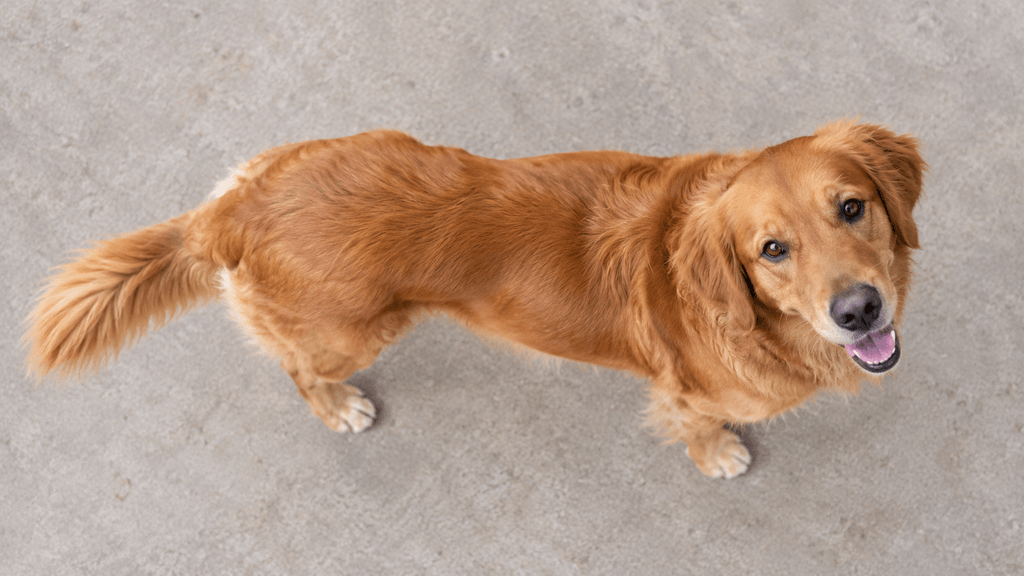
Look from above: can you see a waist?
Stand over your dog and look down at the back. In a dog at a healthy weight, the body narrows behind the ribs and forms a waist. If the trunk looks straight like a tube, or widens towards the sides, it can be a first sign of excess weight.
Feel the ribs: you should be able to find them easily
Run your hands along the sides of the chest without pressing hard. You should feel the ribs under a thin layer of fat, a little like the back of your own hand. If you have to press to find them, or you can’t find them at all, your dog is probably carrying extra weight.
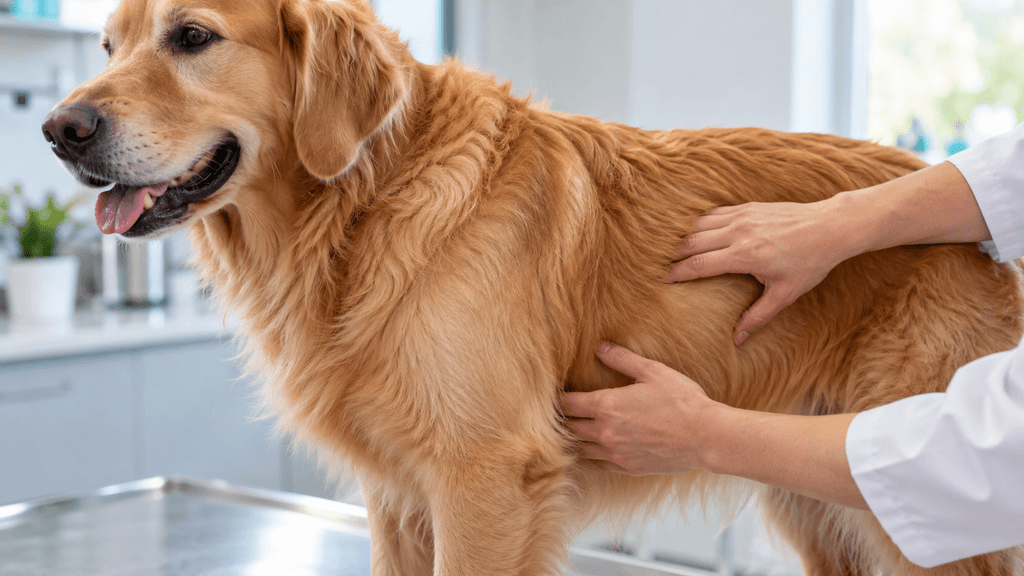
View from the side: a tucked abdomen
Seen from the side, the line of the belly should rise from the end of the chest towards the back legs. A belly that hangs down, or sits level with the chest, points to excess weight.
To sum it up at a glance:
- Healthy weight: a visible waist from above, ribs that are easy to feel and a tucked abdomen from the side.
- Possibly overweight: no waist, ribs that are hard to find and a belly that hangs down or sits level with the chest.
If you can’t decide between the two, that’s normal. In long-coated dogs and in muscular breeds it is easy to get it wrong, and the sensible step is to have a vet assess your dog.
Why the Scales Don’t Tell the Whole Story
Weighing your dog from time to time and writing the number down is a good idea, because it shows whether the weight is creeping up. But a single number doesn’t tell you whether your dog is at an ideal weight: that depends on breed, size, age and muscle mass. Two dogs of 25 kilos can be one in good shape and the other carrying extra kilos.
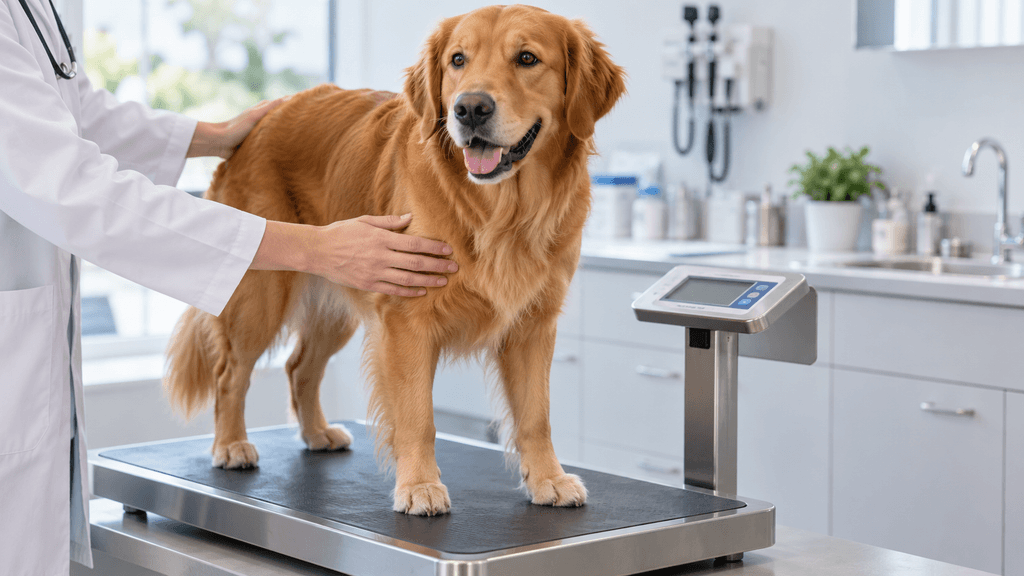
That’s why vets use a body condition scale from 1 to 9, where 4 or 5 is the ideal weight. It assesses what you have just checked: ribs, waist and abdomen. It is the most reliable way to know whether a dog needs to lose weight and how much, and a breed weight chart can’t replace it.
What Are the Health Risks of Excess Weight in Dogs?
Being overweight isn’t just about shape. Over time, it can make a dog more likely to:
- Suffer joint pain and wear, because every extra kilo is added load on the hips, knees and spine.
- Tire sooner on walks and cope less well with heat.
- Put more strain on the heart and breathing.
- Develop conditions such as diabetes.
- Face more risks during surgery or anaesthesia.
That’s why it’s worth acting early, while the change is still small and easier to correct.
Why Dogs Put On Weight Without Us Noticing
There is rarely a single reason. It is usually the sum of small things: treats handed out without counting them, scraps from the table, walks that get shorter with age or a spell of less activity. Age and neutering can also mean a dog needs less energy than before, even if it eats exactly the same.
On top of that comes something very human: it is hard to say no to those eyes asking for food. If your dog is already overweight, adjusting the food by eye is rarely a good idea.
What to Do If You Think Your Dog Is Overweight
- Weigh your dog and note the date. If your dog doesn’t fit on the scales at home, you can pop into the clinic to be weighed.
- Take one photo from above and one from the side. They will help you compare in a few weeks’ time.
- Don’t cut the food on your own. Reducing it suddenly or changing food without a plan can leave your dog short of nutrients it needs.
- Book a check-up. The vet checks body condition, rules out a medical cause behind the weight gain and sets a realistic target weight.
In our nutritional medicine service at Veterinari del Clínic we assess your dog’s condition, help you choose the right food and, when needed, put together a therapeutic diet to control weight. You can call us on 936 090 200 and we will look at it together.
If you also notice that your dog pants after very little effort, tires quickly or struggles to get up, don’t wait for the next check-up. And if your dog has difficulty breathing, call our 24-hour emergency phone line straight away.
A Healthy Weight Is Long-Term Health
Spotting excess weight early is much easier than reversing it after years. Repeat the three-step check every so often, for example when you weigh your dog, and mention what you see at the next check-up. A dog that reaches its senior years at a healthy weight usually moves more comfortably.